Oh, I had to admit it but, many years ago a good friend and I were about to share a bottle of wine and we had no clue how to work a waiter's corkscrew and we shredded the cork.... then tried every tool we could find to get the bottle opened. We finally did it but had bits of nasty cork floating in our merlot.
So, this video is for everyone who has ever wondered how to open a bottle of wine without a corkscrew... watch and remember!
Monday, December 7, 2009

Waiter's Corkscrew

Many people who are new to wine do not know how to use a waiters corkscrew.... it can be very entertaining watching them as they try to figure it out.
Place the foil cutter (the knife part of the tool, may also be a sharp cutting disk) under the lip of the bottle. Press against the foil and turn cutter all the way around the top removing the foil.
The coiled section of a Sommelier knife is called the "worm". Place the tip of the worm just next to the center of the cork. The middle of the worm (where there is no metal) should be over the middle of the cork.
Press the worm into the cork while you twist the worm until it can't go any further into the cork.
Move the lever arm down against the neck of the bottle.
Pull up on the lever (i.e. the handle) firmly. The cork will gently lift up out of the bottle.

Check out the video below to see how to properly use the "waiter's corkscrew".
Sunday, December 6, 2009
Riesling - Another Noble White Grape

Riesling grapes originated in Germany and are considered one of the 'noble' grape varieties for wine making. Riesling is Germany’s leading grape variety and it is considered one of the grape varieties that best expresses the terroir of the soil where it is grown and it is very well suited for slate and sandy clay soil.
| |
| |
| |
Three common characteristics of German Riesling are They are rarely blended with other varietals Rarely ever exposed to commercial yeast Usually never exposed to oak flavor to save its specific tart citrus flavor. In Germany, sugar levels at time of harvest is an important consideration in the wine's production with prädikat levels measuring the sweetness of the wine. As equally important to winegrowers is the balance of acidity between the green tasting malic acid and the more citrus tasting tartaric acid. In cool years, some growers will wait until November to harvest in hopes of having a higher level of ripeness and subsequent tartaric acid.[25] Before modern times, the low winter temperatures in the northern German regions would halt fermentation and leave the resulting wines with natural sugars and a low alcohol content. Every region has its own tradition of wine production, for example in the area of Mosel the wine is usually bottled in tall, green hock bottles. The most prestigious brand of Riesling is the Müller-Thurgau, made in Geisenheim since 1882.  Green - Mosel Brown - Rhine Similar bottles, although brown, are used for Riesling produced in the Rhine region. Riesling is also the preferred grape in production of Deutscher Sekt, German sparkling wine. Riesling wines from Germany cover a vast array of tastes from sweet to off-dry halbtrocken to dry trocken. Late harvest Rieslings can ripen to become very sweet dessert wines of the beerenauslese (BA) and trockenbeerenauslese (TBA) class. Appellations producing the most Riesling wines in the USA: | |
TERROIR - What on earth does this mean?!
 From the web site - http://www.globalgourmet.com/food/wine/2005/w0405.html
Prologue
The Schoonmaker Encyclopedia of Wine, 1955 Edition:
Terrior (tear-wahr) means earth or soil in French. Certain wines have a persistent earthy flavor, called goût de terroir [taste of terroir]. Superior wines rarely if ever have any of this.
1988 Edition:
In addition to meaning earth or soil, terroir is also now being used to describe not only the soil but rather the entire climatic conditions of a vineyard [usually associated with superior wines].
Terrior in CaliforniaSo TERROIR has two meanings, an ominous earthy flavor (a little can be an asset), or it can refer to the total natural physical environment of a winegrowing area, usually as an indication of superiority.
First, let's talk "earthy" flavors. My students usually can spot it in wines from the MOURVÈDRE (also called MATARO). Their favorites, with just enough earth to be an asset, were produced by: • DEAVER• ROSENBLUM
• SOBON
Now to the second meaning of TERROIR. The French created it, and here is how a French vintner describes it in The Vintner's Art by ]ohnson and Halliday: "Terroir looks at all of the natural conditions which influence the biology of the vinestock and thus the composition of the grape itself. It is the coming together of the climate, the soil and the landscape. It is the combination of an infinite number of factors: hours of sunlight, slope and drainage, rainfall distribution, etc." —Bruno Prats, Proprietor of Chateau Cos d' Estournel, St. Estephè While Bordeaux has had centuries to identify, and now promote, areas of superior terrior, California is just starting (somewhat skeptically?) to promote the concept in the Golden State.
The Rutherford Bench in the central Napa Valley is a good example. No district in the New World has a better reputation, or may we say, a better TERROIR, thanks to its remarkable Cabernet Sauvignons. Many of its wines even have a distinctive earthy flavor known as the Rutherford Dust...may we call it a goût de terroir? The best Rutherfords my students have tasted recently were produced by:
• BEAULIEU
• STAGLIN
• PROVENANCE
• SULLIVAN VINEYARDS
• PEJU
• FLORA SPRINGS
• NIEBAUM-COPPOLA
Conclusion
The term TERROIR with several meanings is going to appear more and more in California wine literature. We'll see if it helps all of us with the difficulty of turning wine into words.
Terrior (tear-wahr) means earth or soil in French.
Certain wines have a persistent earthy flavor, called goût de terroir [taste of terroir]. Superior wines rarely if ever have any of this.
In addition to meaning earth or soil, terroir is also now being used to describe not only the soil but rather the entire climatic conditions of a vineyard [usually associated with superior wines].
Grapes used in Winemaking
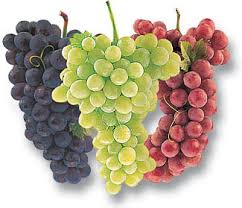
Grapes are the main ingredient that makes a wine taste the way it does and knowing that a certain type of grape is used in a wine let's you know basic information about the wine and what to expect.
Spending some time getting to know how different grapes taste so you learn which you like and don't like, will give you a heads up for selecting wines you'll be most likely to enjoy. Remember - all grapes take on the flavor of the soil where they grow, so knowing what your favorite grapes are and how they vary in taste depending where they are grown helps you narrow down your very favorite wines even more!
I know you are learning so I will often go back and remind what some of the terms mean so you don't have to stop and look them up - eventually these will become easy to remember and you can just skip those paragraphs. I hope to remember to put all of these "blips of information" in purple font so those who don't need to be reminded can skip over them.
When we talk about "varietals" or "varietal wine tastings" think about grapes like horses. All horses are the same species, they can all breed with another horse yet each breed is very different with characteristics that are unique to each breed. So with wine - think of all grapes as part of the grape species - the variety (think breed) is the set of characteristics that make it unique and distinctly different. So within different categories of horses, say work horses, race horses etc there are different types (in wine we say varieties/varietal) - so the categories are RED or WHITE and each varietal (type of grape) is considered to be either a red or a white.
As a rule, when it comes to the names of grapes, winemakers try to adhere to the industry standard. However, some grapes go by different names or spellings and that adds a lot of confusion.
Take the Syrah (or Sirah) grape, which in
If the listings in the reviews or on the labels confuse you find a grape primer or ask the wine store folks - there is a lot to learn and they are often your best teachers.
Most Common Varieties of grapes in United States
WHITE GRAPES -
chardonnay, sauvignon blanc, gewurztraminer and riesling are all common varietals in
Seyval blanc is a North American hybrid that is sometimes called "Indiana Chardonnay."
Other whites that are sometimes grown in
Pinot Grigio, Petit Manseng and Pinot Blanc.
RED GRAPES -
Most red grapes are
Malolactic Fermentation - what is it and why they do it
Malolactic fermentation is commonly referred to as "MLF", or (in winemaker's speak as) "malo" (pronounced may-low).
Malolactic fermentation (or sometimes malolactic conversion) is a process of a change used in winemaking where tart-tasting malic acid, naturally present in grape must, is converted to softer-tasting lactic acid.
Some people refer to this as Secondary Fermentation and the malolactic fermentation requires monitoring just like the primary fermentation. Malolactic fermentation is a process of fermentation where naturally occurring tart malic acid is converted to softer-tasting lactic acid which imparts a rounder fuller mouth feel. This process is under way before, during and after the primary fermentation and is accomplished by naturally occurring lactic acid.
Malic acid tastes slightly of tart apples while lactic acid is richer and more buttery.
Malolactic fermentation (or sometimes malolactic conversion) is a process of a change used in winemaking where tart-tasting malic acid, naturally present in grape must, is converted to softer-tasting lactic acid.
Some people refer to this as Secondary Fermentation and the malolactic fermentation requires monitoring just like the primary fermentation. Malolactic fermentation is a process of fermentation where naturally occurring tart malic acid is converted to softer-tasting lactic acid which imparts a rounder fuller mouth feel. This process is under way before, during and after the primary fermentation and is accomplished by naturally occurring lactic acid.
Malic acid tastes slightly of tart apples while lactic acid is richer and more buttery.
MLF usually occurs shortly after the end of the primary fermentation (when the grape sugar is converted to alcohol by yeast). The family of lactic acid bacteria (LAB); Oenococcus oeni, and various species of Lactobacillus and Pediococcus makes it happen - these bacteria convert one of the two major grape acids found in wine called L- malic acid, to another type of acid, L+lactic acid. This conversion is accompanied by the production of carbon dioxide (so hence the term, fermentation).
Malolactic fermentation (also called secondary fermentation) of the wine occurs in barrel and converts the sharper tasting Malic acid to the softer Lactic acid and is normally done on all red wines. When Malolactic fermentation is complete, the wine gets a dose of sulfur dioxide to kill any micro-organisms and also to protect the wine from oxidation.Wines that typically undergo, and are improved by MLF, are the full-bodied dry whites, such as the California Chardonnays and medium to full bodied dry reds.
NOT ALL WINES BENEFIT FROM MLF - Rieslings are a classic case of a wine that does not benefit.As a general rule, the quality of lighter-bodied fruit-driven wines that require crisp acidity are reduced by the action of MLF.
There is also a major practical reason why MLF is encouraged during the making of many wines, and in particular reds wines that have previously undergone malo in tank or barrel are far less likely to go through malo when in bottle.
The onset of MLF in the bottle is disastrous as the wine will appear to the consumer to still be fermenting (as a result of CO2 being produced). The wine may also lose its fruit integrity and take on the unpleasant lactic aroma of cured meats.
For more information (and for home winemaker instructions) ... please click here.
Saturday, December 5, 2009
Noble Grape - what does this mean?

The phrase "noble grape" is a classical term, not often heard today, used to describe the grapes traditionally associated with the highest quality wines.
To be considered a NOBLE GRAPE -
- It has to be able to make top quality wine by itself without any additions or modifications.
- It has to be grown in different regions of the world, not just in its native region.
WHITES
Chardonnay
Riesling Merlot
Sauvignon Blanc
REDS
Merlot
Pinot Noir
Cabernet Sauvignon
The term is not as commonly used today, partly because of the huge number of hybrid grape varieties, perhaps that is because some feel the term "noble grape" which (originated in France) may unfairly degrades varieties grown in other regions.
Subscribe to:
Posts (Atom)

